


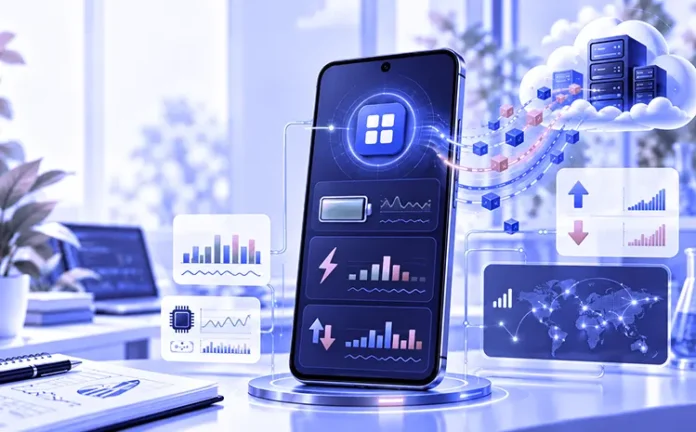
When you use your phone, it consumes electricity. For example, to charge the battery. But the mobile network also needs electricity – as do the internet connection and the data centres through which your apps send and process data. A substantial portion of this electricity consumption occurs during data transmission over the mobile network or internet. You don’t even see this part of the electricity consumption.
How We Test App Data Usage and Network Traffic
To determine how much different apps strain the transmission infrastructure and thus consume energy, we developed a test procedure. In simplified terms, such a test involves the following steps:
We install an app on a test device and launch it. It doesn’t have to be a real smartphone. Occasionally we also use a so-called emulator. This is a computer that pretends to be a smartphone. Our analyst conducts the initial test, clicking through the app. Many apps don’t always behave the same way. For example, some apps only display a specific welcome screen the first time they’re opened or only show ads at certain times. Therefore, we repeat the tests at least three times.
During a test, we redirect the data sent and received over the internet to a computer that we control. There, we can analyse the data. We measure the volume of data transferred and determine to whom or from whom it was sent.
Necessary and Unnecessary App Data Transmission
Almost all apps connect to the internet and transmit data. Such communication is often necessary for them to function. For example, a weather app needs to retrieve weather data for the location where you want to know the weather.
Many apps also transmit data that isn’t necessary for their function. For example, to show you ads. Or to track you – that is, to collect information about you. For example, they track which apps you use and for how long, which websites you visit, and what kind of music you like to listen to.
In most cases, it’s specialised service providers that track you and display ads in the app. These apps then contact not only their provider’s servers but also various other companies that offer advertising and analytics services. We’ve built a database that lists the internet addresses of most of these service providers. If an app sends data to or receives data from such an address during testing, we categorise this traffic as “advertising or analytics”.
If data is sent to a server operated by the app provider itself or which belongs to a cloud service, then we categorise this data traffic as necessary for the functionality of the app itself.
This way, at the end of the test, we can say both how much data flowed in total and what proportion was not absolutely necessary for the function.
What the App Energy Test Results Tell Us
Test results show us a way to measure the data sent by apps and infer their network activity, which could be a factor in electricity consumption. For example, apps sending more data may need more energy for the network infrastructure, although the network’s energy efficiency also depends on the network status and technology. The figures are an approximation of network consumption, not of the total electricity used by the smartphone – screen, processor, and battery recharge.
How We Calculate App Electricity Consumption and Carbon Emissions
The amount of data transmitted is, of course, only one factor when considering the climate impact of apps. Ultimately, what matters is the amount of greenhouse gas emissions generated, as these contribute to climate change.
So we determine the amount of electricity that the transmission equipment would need to transfer the data volume you measured. To estimate the energy use, we use a model based on research that calculates the energy needed to transmit data through a network. This model looks at the amount of electricity used by network equipment and other infrastructure used to transmit data. With this information we can determine the energy use of an app’s network communications.
Limitations of the App Energy Consumption Measurement Model
The values we calculate are not perfectly identical to actual measurements. For example, the model assumes a certain power consumption for the operation of a 4G base station. This assumption is based on average values. In reality, different 4G base stations can, of course, consume varying amounts of power, depending on their age, manufacturer, and transmission power. Therefore, the model only provides an approximate value in each case.
Results can also vary depending on app used, features accessed and tested, and data transmitted in each session. Accordingly, results should be understood as estimates of energy consumption in the testing environment and not definitive figures for all usage scenarios.
Also Read: Apps for Replacing Doomscrolling and Improving Yourself
