



The goal of prompt engineering is to formulate instructions for an AI model in such a way that it delivers the best possible result. The more precise and structured a prompt is, the better the model understands what users want. Prompt engineers have even become a dedicated profession, implementing AI systems in companies. This article provides an overview of what this looks like, examples, and the most important guidelines for efficient prompts.
What Is Prompt Engineering?
A tool is only ever as good as its operator. This principle applies particularly to prompt engineering. Here, the goal is to formulate a command for an AI model in such a way that it delivers the best possible output. Thus, the quality of an artificial intelligence’s response can depend on how precisely the question is formulated.
Prompt engineers create structured prompts by setting rules such as “give me the answer in 3 bullet points with a maximum of 50 words each.” They also ensure outputs tailored to the target audience by assigning roles to the AI, such as “answer from the perspective of an auditor.” Prompt engineering means generating precise, target-group-oriented, and reproducible results.
The work of prompt engineers in a professional setting goes far beyond testing and optimizing individual prompts. They implement AI features into existing workflows and products or create new AI-based products and tools. Precise prompts are also crucial for code quality in vibe coding , i.e., dialog-based programming with AI.
Prompt Engineering Guidelines
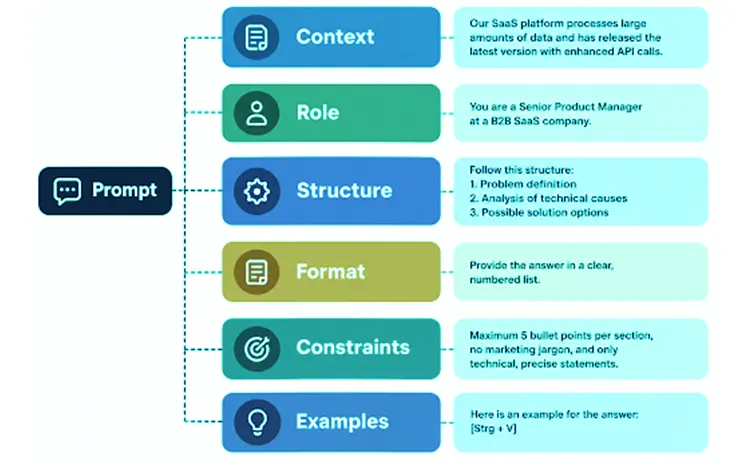
In prompt engineering, clear input can help improve the quality of the output. Clear instructions for the AI not only save frustration but also unnecessary feedback loops. The following guidelines can help:
Assigning Clear Roles
AI models can provide general or superficial answers that may lack the desired level of detail or expertise. This can be countered by defining clear roles such as: “You are a specialist lawyer for commercial law” or “You are a senior product manager.”
Additional information about the context, such as the industry, the goal, tone of voice, or target platforms like web or print, also helps to improve the quality of the response.
Provide Structure
LLMs love structure. That’s why it’s important to create a clear framework, such as: “Answer in tabular form.” A clear outline is also helpful: “Use this structure: 1. Problem 2. Solution 3. Example 4. Conclusion.”
Define Format
If a specific format is required, such as CSV, JSON or HTML, users should state this in advance.
Give Examples
In so-called Few-Shot Prompting, prompt engineers provide the AI model with several examples as a pattern: “Here is an example of the desired format. Please create 10 more examples following the same pattern.”
Setting Constraints
It is also helpful to set firm limits for the LLM, such as a character limit or specific guidelines like “no use of promotional adjectives.” A good approach is to create clear do and don’t lists.
Break Down Complex Tasks Into Steps
Especially with large tasks, it helps to break them down into individual work steps. For example: “1. Analyze the problem. 2. Create a structure. 3. Generate the content based on the previously created structure.”
Forcing the Handling of Uncertainties
When LLMs are uncertain, they hallucinate. This means that rather than give no answer at all, they make something up. To prevent this, it makes sense to give the AI model clear instructions regarding uncertainties: “If you don’t have reliable information, write: ‘I have no confirmed information on this.'”
Additionally, it makes sense to have the AI support its answer with sources. These should absolutely be checked, as hallucinations can also occur here.
Also Read: How Do I Use Chat GPT At School?
Prompt Engineer Salary: What Does a Prompt Engineer Earn?
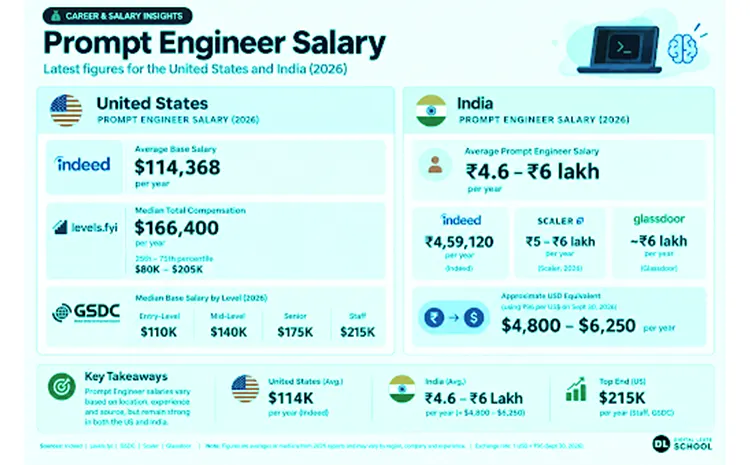
The job profile of a prompt engineer is relatively new, which is why there are no reliable salary statistics yet. Furthermore, the interpretation of the role profile can vary considerably from company to company.
Comparable AI-related professions can provide a benchmark for potential salaries, but compensation varies considerably depending on the role, experience, location, and employer.
Prompt Engineering Techniques and Types of Prompts
In addition to the general guidelines mentioned above, there are various prompt techniques depending on the desired output. These allow for targeted control of the response accuracy. Here is an overview of the most common prompt engineering techniques:
| Prompt Engineering Technique | What It Does | Example Use |
| Zero-Shot Prompting | Gives an instruction without examples | Summarizing a document |
| One-Shot Prompting | Provides one example | Following a specific format |
| Few-Shot Prompting | Provides several examples | Matching tone or structure |
| Persona or Role Prompts | Assigns a role to the AI | Responding as a product manager |
| Chain-of-Thought (CoT) | Guides the model through multiple steps | Solving a complex problem |
| Tree of Thought (ToT) | Explores multiple possible solutions | Comparing alternative approaches |
| Contrastive Prompting | Requests contrasting approaches | Comparing risky and conservative options |
| Red-Teaming Prompt | Looks for weaknesses in a response | Testing an AI-generated answer |
| Expansion Prompting | Develops an idea in multiple directions | Brainstorming |
| Meta Prompting | Improves or generates a prompt | Creating reusable prompts |
Zero-Shot Prompting
This is a form of prompting where the instruction or question is formulated without providing examples of the desired output.
This approach can be useful for some tasks, such as creative brainstorming. Similarly, when summarizing or translating a text, additional context may not always be necessary.
One-Shot, Few-Shot, and Multi-Shot Prompts
Users provide the AI with one or more examples of the desired output before entering their actual prompt. Based on these example responses, the LLM is able to better understand what kind of answer users expect. This technique is particularly efficient for understanding tone and style, as well as the structure of, for example, tables and texts.
Persona or Role Prompts
Prompt engineers assign a specific role to the AI model. They specify that the LLM should respond, for example, as a product owner , senior developer, or business expert. Role prompts are particularly useful when perspective, target audience, or expertise plays a role.
Chain-of-Thought (CoT)
This is a prompt engineering technique in which users ask the AI model to work through a problem step by step.
This form of prompting can be useful for tasks that involve multiple steps or complex reasoning. It’s not just the outcome that matters, but also the process leading to it and a coherent line of reasoning. Product managers, for example, can incorporate this line of thinking into their decision log.
Example of a Chain-of-Thought Prompt
Example of a chain-of-thought prompt : “Think step by step: Our server has been using significantly more RAM since the last deployment. What are the two most likely technical reasons? What should we check first?” It can also be useful to have the AI perform multiple rollouts for the same question. This allows you to verify whether the answer is highly reliable or whether the AI arrives at different results for the same or similar questions.
Tree of Thought (ToT)
This is a more complex approach that explores multiple possible solutions to a problem and evaluates different alternatives.
Example of a Tree of Thought Prompt
Example : “Think in terms of multiple solutions: Our Python app becomes unstable under load. Generate three alternative explanations, briefly evaluate them, and decide which is most likely.”
Contrastive Prompting
AI models tend to reflect the consensus. For some questions, it can be useful to force the model to differentiate, such as: “Give me a risky and a conservative solution.”
Red-Teaming Prompt
Prompt engineers instruct the LLM to question its own response. This allows potential weaknesses to be identified.
Expansion Prompting
This technique can be used, for example, for brainstorming in product development . Users instruct a LLM to expand on an idea and think in multiple directions.
Meta Prompting
The AI first generates or improves a prompt before delivering a result. The goal is to create a structured, reusable thought process that can be applied to similar problems.
Also Read: From Prompt to Product: How Vibe Coding Tools Are Rewriting Development